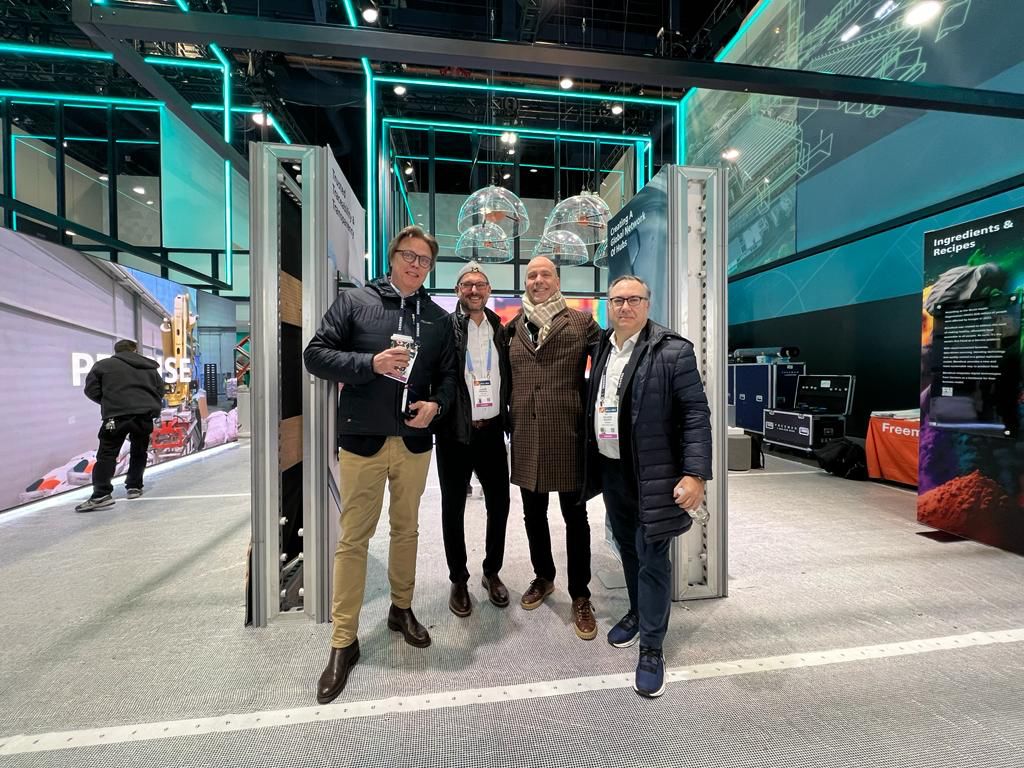
As you know, last week we were participating in CES Las Vegas, the most impactful technology event in the world, invited by Siemens, our technology partner.

As part of Siemens’ goal to unveil how their technological innovations are reshaping the consumer, retail, and food and beverage industries, we were invited to present our model of multi-localized portable plants, supported by their technology, to produce closer to raw materials and final consumers.

Our visionary business model, supported by Siemens’ cutting-edge technology, is helping companies from all around the world to accelerate innovation and access new markets.

At CES we presented our Full Meals project to feed more people in more places, especially in underserved communities. It is an example of how the multi-localization strategy enables us to ensure the provision of nutritious, sustainable and affordable food, while ensuring value creation and benefit for all parties involved. A committed yet profitable business model.

With more than 1,000 visitors to our stand showing great interest in our business, we have demonstrated our potential to transform the food industry. This will allow us to expand our collaboration with Siemens, which will open great opportunities for Blendhub, but also for our customers, partners and suppliers like you, who are part of our project.

47 grams of food powders can truly make an impact! 

Here is a short video of our amazing experience at CES 2024, PLAY IT! ⬇▶

Thank you for your trust. Let’s keep moving forward together!

CES is the most powerful tech event in the world, the proving ground for breakthrough technologies and global innovators.

Blendhub is participating in CES in Las Vegas, the world’s most important technology event, taking place from January 9 to 12. As part of the Siemens presence at CES, Blendhub is demonstrating how it is using Siemens technology to transform the global food system.

Blendhub was invited by Siemens to present its Food-as-a-Service model, which sets a new standard in efficient, sustainable food production, delivering tangible benefits for the industry. Enabled by Siemens technology, this approach actively creates a circular economy, benefiting local producers and communities, the environment and long-term economic sustainability.  

Blendhub is using Siemens’ Digital Twin technology to optimize food production and it is helping Blendhub achieve its goal of transforming food production in a more efficient and sustainable way, and to facilitate access to healthy and affordable food products to more people in more places.

At the Siemens booth at CES (Booth 10044 LVCC North Hall), Blendhub will showcase its global network of portable production plants, an initiative that the company has pioneered worldwide. Portable Powder Blending (PPB) Hubs are mini-Food and Beverage factories that can be sent and deployed anywhere in the world in a matter of weeks.

With all hubs connected to the cloud, food products and every single ingredient, and batch can be authenticated and monitored, enabling the perfect replication of recipes, anywhere.

Dave Taylor, VP of Industry Strategy and Marketing at Siemens Digital Industries Software said, “At CES 2024, Siemens is highlighting how customers like Blendhub are using the Siemens Xcelerator open digital business platform to transform how people live, work, play and make.  We hope to inspire many more people to embrace the power of Siemens technology like Blendhub has, so they can transform the everyday.”.

And Henrik Stamm Kristensen, Founder and CEO of Blendhub, states: “At the heart of Blendhub’s operations, supported by Siemens technology, is a deep-rooted commitment to sustainability. Blendhub’s localized production models minimize environmental impact and lead to significant cost savings, combining social accountability with economic benefits”.

Blendhub’s scalable cloud-based recipe development system is revolutionizing the food and beverage industry by fostering real-time collaboration, centralizing data storage, and empowering businesses to gain insights into recipe performance and ingredient costs, thus facilitating innovation and access to new markets, driving sustainability and positively impacting local communities.

Magnus Edholm, Aaron Frankel, Henrik Stamm Kristensen and Eduard Marfa.

As we finish another year, we look back on the milestones of 2023. At the top of our agenda has been a reorganization of Blendhub, focused on cultivating a team of top performers to drive short term profitable growth and improving everyday operations in coordination between local hubs and global teams. At the same time, we have been laying the strategic foundations on which we will grow our business rapidly over the next 3 to 5 years.

The food industry is ultra-dynamic and rapid innovation is forcing everyone to change our approach to business. We are adapting to these rapid changes by enhancing efficiency in all our operations, demanding better profitability, improving coordination in our network of hubs, and doubling down on our vision for shared value creation for our suppliers, customers, and other business partners.

To facilitate this change, we have structured the company into four business verticals in 2023, to help us position our current and future talent where they can create most value.

  • Blendhub Blends & Services (known internally as 20/20) – operates our global network of hubs, ensuring existing customer satisfaction and new customer development, based on wide technical experience in various food segments shared across our network in tandem with local product adaptions. It offers functional blended solutions and industrial services. 
  • Blendhub New Hub Deployments – focuses on expanding our capacity as required or building strategic alliances with customers, suppliers, and financial investors for local production.
  • Innovation and Co-Creation – takes care of the design and development of new products combining our internal knowledge with new data sources, offering innovation services to both our internal Blendhub teams as well as other companies and entrepreneurs. It sits at the core of the digital and cultural transformation towards our vision of becoming a global Food-as-a-Service platform.
  • Chemometric Brain – is a key tool for us to offer traceability and transparency of our raw materials and blended products, thanks to its use throughout our production network. Beyond Blendhub, they offer companies with better and cheaper testing solutions for quality control, leveraging NIRS to build solutions for any food segment.

We have also reinforced our management structure with the incorporation of top professionals with contrasted experience. José Luis Fernández, our new CFO, has a strong vision on financial control, turn-around and expansion, and has joined our executive committee. Also joining our management are Víctor Núñez, leading corporate development, and Guillermo Cánovas, leading our legal department.

WEF Top Innovator

A key milestone this year has been our participation in the Humanitarian and Resilience Challenge by UpLink, a platform promoted by the World Economic Forum. We were selected as one the 10 Top Innovators in this challenge for empowering employment and entrepreneurship in vulnerable communities and contributing to a positive social impact worldwide by leading the way in a global food system change.

This has opened new opportunities for us in a segment, Human Resilience, where we until now did not have broad recognition as a supplier. Serving humanitarian organizations and collaborating with governments brings us closer to our vision of making healthy and affordable food and personalized nutrition available to all people in all places, sustainably.

Leading the transformation in the food industry

Innovation and Co-Creation had a very interesting collaboration this year with EIT Food, an EU funded food innovation engine, for the Affordable Nutrition Scale Up Challenge. 10 European startups and scale ups were selected and economically awarded for their innovative ingredients or products contributing to the promotion of healthy and sustainable diets in Europe.

Through the project, we’ve been able to establish relationships with and learn from a group of young and innovative companies, with whom we are working to bring their ideas to market in the coming months.

When 1+1 is more than 2

Core to our strategy are the partnerships with value-aligned entrepreneurs and companies to create shared value. We’d like to highlight some partnerships signed this year:

  • Indespan – producing and marketing novel bakery and pastry solutions
  • Upfood – developing innovative and nutritious ingredients from food surplus
  • Foodiq – collaborating on the development and production of alt protein based dairy alternatives
  • ColoPlus – supporting their launch of nutraceutical food products using bovine colostrum.

And we’re off to a flying start in 2024, presenting at CES in Las Vegas in January, invited by our global technology partner Siemens.

As you can see, both our business and global relationships continue to grow and we believe this to be the key to accelerate transformation of the global food system to a more efficient and sustainable one, benefitting people and planet.

I want to thank all our suppliers, customers, and many other valuable relationships, both the organizations and the people, for their trust in Blendhub. We look forward to continuing to travel this path together.

Best wishes for health, peace, and success in the new year 2024.

Henrk Stamm Kristensen

Founder & Chief Moonshot Officer

Together with platform partners, 3D Essence Food, LeanPio, Indespan and Chemometric Brain, they will present innovative solutions in nutritional bakery solutions, personalized nutrition, food surplus utilization, waste management and digitized food quality software among others.

Blendhub will be present again at Food 4 Future, May 16-18 in Bilbao, Spain. Being the leading food tech event in Europe, latest trends and innovations that are transforming the food industry will be presented.

Blendhub is official sponsor of the event and will participate with a booth hosting some of its key platform members. The aim is to show how collaboration between different stakeholders operating in the agrifood value chain can accelerate the development of a more efficient, sustainable and safe food system for consumers and the planet.

Since last Food4Future event in 2022, Blendhub has accelerated its Food-as-a-Service value proposition to facilitate entrepreneurship in the global food sector by supporting startups, SME scale ups and food industry organizations in general from idea to test, product validation and market launch of innovative food products containing powder based food ingredients anywhere in the world. This is possible due to the operation of a global network of food production hubs already covering 4 continents and a unique approach to local consumer market knowledge acquired by both physical presence and the collaboration with platform partners from around the world.

Visitors and food industry stakeholders will be able to visit a complete production hub according to the Blendhub replication model in virtual reality and discuss specific business opportunities around shared value creation on this innovative FaaS platform business model.

Interested partners and investors can also get an understanding of how new food production hubs can be deployed anywhere in the world in less than 6 months and how these new local and regional deployments of the modular and portable food production facilities can support the transition towards a healthier and equitable food system.

Chemometric Brain and their digitized food quality software which is operating as an independent module installed in all Blendhub facilities, will present their new software solutions for quality control of dairy products, powder based food ingredients, snacks and 100% acorn-fed Iberian ham, among others, and will perform real-time analysis of food samples, showing immediate results.

The platform partners will showcase some of their latest innovations for the food industry. Indespan will present a novel solution to produce bakery products with a high vegetable protein content. This new protein bread, which is already being successfully produced and marketed through Blendhub’s multi-localized network, will be part of the menu during the CEO and senior executive network lunches that will take place during the event.

LeanPio will introduce its latest eco-efficient solutions to help companies minimize waste and optimize resources; and 3D Essence Food, specialized in the use of production surpluses to curb waste and generate new foods with high nutritional value, will demonstrate 3D printing of food from these surpluses.

“With our partners we reinforce our Food-as-a-Service strategy to empower entrepreneurship and innovation in the food industry. Through our partner network and multi-localized production hubs, we help companies detect market opportunities to launch healthier, sustainable and affordable food anywhere in the world, and focus on enabling startups and SMEs to compete with large multinational food companies at the same level”

Henrik Stamm Kristensen, founder and CEO of Blendhub and Chemometric Brain.

In addition, Blendhub, Chemometric Brain and its partners will participate in the Food 4 Future World Summit, which will host high-level international speakers to discuss the challenges facing the food and beverage industry.

Blendhub – 16 May– Arena Industry Solutions – Food as a Service, a shared-value innovation model, with Joaquín Tintoré King, Head of Business Development.

Chemometric Brain – 16 May – Arena Industry Solutions – Better quality and decisions, with digitized quality control, with Jacob Kristensen Illán, VP Digital Food Quality.

Henrik Stamm Kristensen – 17 May – Main Auditorium Agrobank – Is innovation Still Relevant at Yhis moment in Time?

We offer you a business pass to the event and look forward to welcoming you at our booth, Visit us at F600 from May 16 to 18 at the BEC in Bilbao.

CODE PASS: RVBXQ

Blendhub has been selected as one the 10 Top Innovators in the Humanitarian Impact and Resilience Challenge by  UpLink, the innovation platform for people and planet by World Economic Forum.

Blendhub was chosen for empowering employment and entrepreneurship in vulnerable communities and contributing to a positive social impact worldwide by leading the way in a global food system change.

This award recognizes many years of hard work with the objective of deploying a global network of multi localized food production hubs, digitizing food products to develop sustainable global supply chains and create a completely new offering Food-as-a-Service making healthy and affordable food and nutrition available to more people in more places.

Blendhub uses technology, data and a global infrastructure of multi-localized food production hubs to make nutritious and affordable food and personalized nutrition available to more people in more places through a collaborative platform business model. The network of Food-as-a-Service hubs, located closer to ingredients sources and/or closer to final consumers, serves to empower local communities to increase local value creation, while at the same time finding additional skills or missing parts needed to develop new food solutions from a global community of food industry companies and experts.

Our objective is to help anyone from idea to market launch of new food products containing powder-based food ingredients directly to consumers (B2C) or converted through industrial processes (B2B) into solid, liquid, or gelled ready-to-consume food products, faster, safer and cheaper than ever before – and all from sustainable global supply chains.

The Humanitarian Impact and Resilience Challenge was a global call for commercially viable and scalable private/public driven efforts that benefit the recovery of local communities that are at risk or have suffered from conflict, natural disasters and forced displacement.

The need to find new ways to help those affected by fragility, conflict, violence, extreme hunger, and natural disasters has never been as urgent. Even before the COVID-19 pandemic and the Ukrainian refugee crisis, nearly 1 billion people were living in fragile settings across the world.

While established humanitarian and development responses will remain essential as relief to acute crises, there is an opportunity to complement established approaches with market-driven solutions that provide a financially sustainable approach to humanitarian action, systemically changing our collective approach to preventing and responding to crises and fragility.

EIT Food and Blendhub launch the Affordable Nutrition Scale-Up Challenge with the aim of ensuring that more people have access to sustainable and nutritious food. Both organisations are looking for startups and scaleups that have ingredients or formulas that support the promotion of healthy and sustainable diets in Europe. EIT Food is supported by the European Institute of Innovation and Technology (EIT), a body of the European Union.

The goal of the Affordable Nutrition Scale-Up Challenge is to help bring innovative powder-based food solutions to the next level. The most promising submitted initiatives will be selected by a jury committee and up to ten winners will receive services worth €25,000 to go from ‘idea to market’. 

Solutions submitted to the challenge should seek to dramatically improve an existing recipe; find a larger formula or recipe in which the innovative ingredient could take place because it is currently under-utilised; expand to new markets by localising the recipe or further develop the category with a new range of sub-products.

Innovating all along the food supply chain – finding new raw material sources, developing alternative nutritious solutions, and achieving more sustainable and cost-effective processes – is not an easy task.

New food companies encounter barriers such as market segmentation, high development costs, lack of data to ensure success and efficient supply chains, and achieving mass-market food quality.

Blendhub’s expertise in powder-based food products, together with EIT’s demonstrated experience and international network, will help food companies surpass these innovation barriers and speed up the time it takes to ideate, test and launch a new product onto the market, delivering more nutritious, healthier, and affordable food products to consumers.

Lorena Savani, Innovation Programme Manager at EIT Food, said: “By supporting the Affordable Nutrition Scale-Up Challenge, EIT Food aims to accelerate innovation in the food industry and ensure that more people have access to sustainable and nutritious food.

“We are excited to partner with Blendhub and leverage their expertise in powder-based food products to help startups and scaleups overcome innovation barriers and bring their ideas to market. Together, we can build a future-fit food system that produces healthier and more affordable food for all.”Henrik Stamm Kristensen, Founder and CEO at Blendhub, stated: “This initiative in collaboration with EIT Foods is fitting perfectly into our collaborative food industry platform strategy and is an excellent

opportunity to demonstrate how we can help entrepreneurial people and companies taking their new food product ideas to market faster, safer and cheaper on our global network of multi-localized hubs, which we are deploying closer to raw material producers and closer to consumers supporting sustainable global supply chains and a transiting towards a circular food economy” .

“We cannot achieve this goal alone. Multiple stakeholder collaboration and transparently shared value creation is key and with this challenge we expect to open the eyes of many value-aligned professionals and companies to join the movement and transform the global food system together”.

Applications are open from 12 April 2023 to 15 June 2023.

I recently read an interesting article in Food Manufacture UK that invites all of us involved in food production to reflect.

Most importantly, when referring to food security, do we really know what it involves?

It is generally defined as the state of having reliable access to a sufficient quantity of affordable and nutritious food.

It is a different concept from food safety but there is an interdependency between both: if the food is not safe, food security is not relevant, and if there’s no food security, food safety is secondary or simply irrelevant.

The last years have revealed significant vulnerabilities in global supply chains, especially with shortages of certain food items, first due to border closures and limitation of activities due to the Covid pandemic, then the war in Ukraine, and energy and transport price increases just to mention a few.

All this is leading to an increase in food insecurity and in many cases to a complete lack of availability of food, especially in the poorer part of the world.

Climate change is another reason for the lack of food security.  There is no food if there is no fertile soil, there will be less food if we have less water and if the temperature increases, certain crops will disappear, all challenging our agricultural supply chains in multiple ways.

In my opinion, the keywords to tackle these challenges are localization and decentralization.

I will never stop insisting on this, and the reality is proving us right again and again. Since we implemented our first localized food production hub more than a decade ago in India and now have deployed a network of multi-localized production hubs already on 4 continents and growing, we are successfully helping food companies to reformulate and optimize their existing food products’ cost and quality, adapting them to local ingredients availabilities, optimizing their supply chains and even by helping them from idea to market launch of new and sustainable food products faster, safer and much cheaper than ever before. The new keywords today are speed and agility.

Localization of production is key to producing more efficiently and at a lower global cost. It empowers more value creation in local communities, contributes to reducing gas emissions, minimizes risks, and ensures the supply of healthy and affordable food and nutrition in sustainable global supply chains for more people in more places.

But food shortages also create important collaterals, especially putting food safety at risk.

When some food products become scarcer, their value increases and fraudulent activity increases alarmingly like in olive oil, honey, spices, and many other food products.

According to experts in quality control, a risk-based approach should be used to define the amount of testing to carry out. Depending on the track record and confidence of the supplier, they recommend more or fewer lab analyses.

But these same experts also recognize that external lab testing is time-consuming and costly, and therefore many times the number of samples analyzed is limited. Instead, testing in-house can ensure full control of the entire production process, and many technologies like Near Infrared Spectroscopy (NIRS) are already invented, however still heavily underutilized despite their proven results in the food industry.

We at Blendhub were pioneers in developing and adopting Chemometric Brain, a NIR-based software that allows fast and effective analysis of all raw materials and final products without the need for specialized technicians or large investments into our supply chains and global network of food production hubs. Today we use this technology to control every single batch entering, and final blended product leaving our hubs anywhere in the world. Chemometric Brain is today an independent company serving food industries in Europe, LATAM, and Africa.

As mentioned, re-formulation must be considered key to addressing the scarcity of traditionally available ingredients or ingredients being transported from far away.

Alternative and locally available ingredients should always be considered for product development, especially plant-based ingredients, or millet, which in addition to being nutritious grow in harsh and dry conditions, save water, and increase yield, and should therefore be a growing source of food.

Also exploring new ways of using surplus fresh food is a way to tackle food shortages and foster sustainable food production.

Thousands of tonnes of fresh and edible surplus are wasted every single day in the world and collaborations like the one we have been working on for more than a year with Essence Food in the development of new healthy, dried, powdered, and nutritious products from surplus food is a good example of accelerating food safety and food security through partnerships.

As you can see in Blendhub we are trying to explore solutions in many different manners to increase food security and food safety in many parts of the world but it is also absolutely clear to us that we need many more value-aligned people and companies that believe what we believe and are ready to collaborate in a transparent and accountable manner to make the accelerated impact needed to make healthy and affordable food and nutrition available to all people in all places.  

More than a decade ago at Blendhub we had the strategic vision to transform our centralized business model toward localization. This made us pioneers in 2011 when deploying our first portable powder blending unit (PPB) in India with the objective of reducing the time and costs, of buying the ingredients, blending, and packaging a specific food formulation, and supplying it to a B2B food industry customer in the Middle East. And we succeeded big time: we reduced global supply chains with +70 days, reduced inventory substantially, and saved 30% of the food product cost while at the same time reducing gas emissions due to optimized logistics.

The magic “recipe” was localization: localizing production closer to raw materials and closer to end consumers to be much more cost-efficient and operate sustainably.

Today, the context in which we live has proven us right: it was not only a good strategy to reduce costs and be more efficient for our customers. The Covid pandemic, global warming, and the increasing digitalization and automation of processes are leading to changes in the markets that demand fast and agile adaptation and market launch of new solutions.

And localization is the keyword. Localized food production facilitates local entrepreneurship, network, and consumer understanding, increases operational performance and efficiency in the food system, and this results in higher resilience and lower risks.

Visionary food producers start to see hyperlocalization as a clear way to improve the industry’s resilience and thereby take advantage of an entirely new way to become competitive while at the same time reducing emissions and lowering climate impact. 

As noted in the last Intergovernmental Panel on Climate Change report, hyperlocalization involves creating shorter supply chains and establishing or redesigning operations to allow food production to occur in the same local environment as the end consumer. With a focus on shorter, transparent, and more sustainable supply chains, localization is evolving into hyperlocalization, producing food as close to consumers as possible. The big and centralized food factories will soon be history.

Years ago, when I first raised the need to localize food production closer to raw materials and final consumers, I had to fight against the incomprehension of an industry that was still too traditional and conservative. Today, with Blendhub operating 7 plants on 4 continents and a unique Food-as-a-Service (FaaS) business model helping companies of any size to produce anywhere in the world, I celebrate that the industry is adopting hyperlocalization to produce more efficiently and sustainably, thus ensuring the supply of basic and nutritious food products to feed more people in more places.

Hyperlocalization is also about revitalizing local crops and empowering local farmers to become the new FMCG companies of this new world. A clear and recent example is millets, due to their importance as a staple food, which is usually grown in developing countries and has a huge and untapped potential in the global food industry. That’s precisely why the UN and FAO have declared 2023 the international year of millets to promote their cultivation, processing, and consumption, encouraging the different stakeholders in the supply chain to work together to exploit this potential and not just cry over the lack of traditional crop availabilities.

Two years ago, we at Blendhub took the lead in the Revaluation of the Ragi (Finger Millet) Supply Chain in India to create healthy and affordable nutrition around a highly undervalued local raw material. We are now helping farmers and entrepreneurs from idea to market removing inefficient steps and costs along the supply chain and facilitating access to healthy and nutritious novel products in a unique shared value model.

Achieving full hyperlocalization may be challenging but the absolute key is multi-stakeholder collaboration and not the one we know today where “winner takes all”. We are dealing with many different challenges at the same time including lack of supply chain transparency, food traceability, food fraud, food loss, and food waste to name a few, and all being shared by more than 500 million farmers and SMEs apart from the big multinational food industries.

Localization is a complete game changer in the global food system and the rules of how to operate and create shared value will never be the same again. It is just a question of time.

For a company in continuous evolution and improvement like Blendhub, at the end of the year it is mandatory to look back over the past months: have we achieved the goals we set for 2022?

Let’s start at the end. Just a few days ago, Blendhub received the annual award for Excellence in Social Impact from the World Economic Forum’s New Champions community. A great end to the year!

This is an award for perseverance, for fighting for what you believe in, despite difficulties and misunderstanding. Because it recognizes that our multi-localization model and platform collaboration are key to continue creating value for the food industry and, ultimately, for society.   

It is also a very significant award because it recognizes the importance of SMEs in global economic development. A recent World Economic Forum report on the subject warns that 67% of SMEs are attempting to cope with growth and are struggling to survive. If we take into account that SMEs are responsible for 80% of food production, this becomes even more significant.

This is precisely the challenge that inspired our collaborative platform business model, which we have definitively consolidated in 2022. What seemed so far away in 2011, when we reoriented our business model towards multi-localization and service, is today a successful reality.

Multi-localization and Food-as-a-Service to create shared value

We have built a platform for professionals, companies and organizations sharing our purpose and values and willing to create shared value and generate a sustainable impact on the global food system.

Our suppliers, freelance formulators and partners are directly involved in our projects in close collaboration with our local hubs to develop new, more efficient and sustainable food solutions.

This enables us to offer Food-as-a-Service anywhere in the world to any food company, from idea to launch in less than 90 days.

In the last year, SMEs and large multinational food companies have chosen Blendhub to innovate in plant-based products and other personalized and healthy nutrition trends. In Latin America, for example, we have launched a new range of instant beverages made from vegan ingredients and we are revolutionizing the market with a new high-protein bread.

In India, we have launched our most ambitious project for the revaluation of the Ragi supply chain with the objective of creating nutrition and business around a local raw material that is highly undervalued but has great potential. The project involves farmers supported by eKutir, humanitarian organizations led by Partnerships for Change, and has been implemented thanks to Blendhub’s production capacity and expertise.

This project encompasses everything that Blendhub is all about: localization of food production, empowerment of local farmers and SMEs, promotion of local development, platform collaboration, solidarity and creation of shared value for all parties.

Middle East, our immediate project

In 2023, we will continue creating partnerships to strengthen our platform and to improve and expand our Food as a Service system in order to continue offering innovative, efficient and sustainable solutions anywhere in the world.

We are now working to deploy our platform in the Middle East, one of our key markets since our origins, with great growth potential.

The outlook for the future is therefore very optimistic. Thank you, once again, for continuing this path together, because everything we have achieved so far has been thanks to a strategy of shared value and because of your trust.

I wish you all health, happiness and success in the new year.

Henrik S. Kristensen

The company belongs to the World Economic Forum’s New Champions community, which brings together mission-driven MidCap companies with disruptive business models and sustainable growth strategies.

Blendhub has been granted the Excellence in Societal Impact Award at the get-together of the World Economic Forum’s New Champions Community celebrated in Geneva last week. These awards recognize the efforts of developing innovative solutions to generate positive social impact, accelerate technological transformation and innovation, and promote governance for good.

Blendhub is a member of the World Economic Forum’s New Champions community as of May 2022. The actual +120 members of the New Champions community, from +45 different countries, are dynamic, high-growth purpose driven mid-sized companies that have demonstrated a strong capacity and strategic thinking to develop sustainable solutions that can generate a positive impact on people and the planet.

Every year, the Forum recognizes the best from this cohort with the New Champions Awards. This year’s categories focused on sustainable growth, societal impact, and adaptive capacity in the face of difficult times. The projects were selected because of their originality, impact, and scalability.

In Blendhub, the jury valued the company’s disruptive platform business model, focusing on more efficient and sustainable food production using digitized food quality to elevate food safety and security beyond traditional certifications and capable of generating positive social impact in line with the United Nations Sustainable Development Goals.

Henrik Stamm Kristensen, the founder of Blendhub, stated:

“This award not only recognizes that our model of multi-localization of production is the most sustainable and cost-efficient way to ensure basic and safe food to more people in more places but also proves that collaboration between the different stakeholders in the food supply chain is crucial to continue creating value for society and planet”.

Blendhub is a Spain-based company operating globally and deploying a network of multi-localized food production hubs closer to raw materials and final consumers, self-financed to date but opening for the expansion of the network with local/regional partners and investors fully aligned with the purpose of the company. The Food-as-a-Service business model helps people and companies from idea to launch of healthy and affordable food and nutrition anywhere in the world, faster, safer, and cheaper than ever before with the purpose of feeding all people in all places, sustainably.

About the World Economic Forum

The World Economic Forum is the International Organization for Public-Private Cooperation committed to changing the state of the world. Headquartered in Geneva, Switzerland, the Forum engages the foremost political, business, cultural and other leaders of society to shape global, regional and industry agendas. It was established in 1971 as a not-for-profit foundation and is headquartered in Geneva, Switzerland. It is independent, impartial and not tied to any special interests. The Forum strives in all its efforts to demonstrate entrepreneurship in the global public interest while upholding the highest standards of governance. The Forum believes that progress happens by bringing together people from all walks of life who have the drive and the influence to make positive change.

Please visit https://www.newchampions.org for more information about the New Champions Community.