Food safety contributes to food security and health and must be guaranteed by governments, according to the FAO and WHO. At the same time, it promotes more sustainable development.

Food safety and sustainability are thus two interconnected concepts and key topics for the future of the food industry, which will be addressed at the upcoming Congress on Food Safety and Sustainability, organized by Veraliment on November 11 and 12 in Valladolid.

Current challenges

During the congress, several essential topics will be discussed:

Food Safety: Issues related to crisis management and primary production, fundamental to ensuring food supply security, will be covered.

Sustainability: How food sector companies can integrate sustainability into their operations while also achieving tangible benefits will be explored.

Culture and Soft Skills: Best practices from food companies will be shared to foster a collaborative and efficient work environment.

Digitalization and Artificial Intelligence: Tools revolutionizing the sector will be presented, highlighting the role of digitalization and AI in production and quality control.

Blendhub and Chemometric Brain: Leaders in digitalization

As pioneers in digitalization and the implementation of advanced technologies for food production and quality control, Carlos Calleja, IT Director of Blendhub, will be a guest speaker at a roundtable on AI and digitalization.

Jacob Kristensen, VP of Chemometric Brain, and David Torres, Director of Blendhub’s Spain hub, will participate in a debate on artificial intelligence applied to the food industry.

This will be an excellent opportunity to share our experiences and insights on how these tools can transform the food industry.

See you in Valladolid on November 11 and 12 to continue driving the transformation of the sector!

Blendhub strengthens its sales team in the Middle East, one of the company’s priority regions, with the appointment of Adil Benjelloun.

Born in Bordeaux, France, and raised in Casablanca, Morocco, Adil holds a degree in International Business and Strategic Management from McGill University in Quebec, Canada.

His professional journey has taken him from the bustling markets of Morocco to the dynamic landscapes of Montreal

Fluent in French, Spanish, Arabic, and English, he thrives in diverse environments and embraces the richness of different cultures.

Over the past decade, he has lived in Mexico, Paris, Morocco, and Dubai, each location adding a unique thread to his global tapestry.

As regional sales director for Blendhub in the region, his role is to drive strategic market expansion, focusing on both day-to-day customer service with an extensive team of both local and International professionals as well as participating in high-level strategy development and partnership development.

We are happy and proud to have a top-tier professional like Adil on our team, and feel confident that he will contribute to the company’s growth through focusing on always improved customer service and expansion of our Food as a Service strategy in the region.

Welcome aboard, Adil!

Greek yogurt has become a staple in many households, celebrated not only for its delicious taste but also for its impressive nutritional profile. With its high protein content, thick and creamy texture, and numerous health benefits, it’s no wonder that Greek yogurt is cherished by health enthusiasts and foodies alike.

Why is Greek Yogurt so appreciated

1. High Protein Content

With nearly double the protein of regular yogurt, it’s an excellent choice for anyone looking to increase their protein intake, making it a favorite among athletes and fitness lovers.

2. Thick and Creamy Texture

Greek yogurt is known for its rich and indulgent texture. This thickness not only makes it satisfying to eat but also versatile for cooking and baking, adding creaminess to smoothies, sauces, and desserts.

3. Rich in Probiotics

Greek yogurt is a fantastic source of probiotics, the beneficial bacteria that support gut health.

4. Nutrient-Rich

Greek yogurt is packed with essential nutrients, including calcium, vitamin B12, and potassium.

5. Reduced Sugar Content

Many brands of Greek yogurt offer options with reduced sugar, making it a healthier choice compared to traditional yogurts.

6. Versatility in Cooking

It can be used as a base for dressings, dips, smoothies, and baked goods, allowing for healthier substitutions in recipes without sacrificing flavor.

But what if Greek Yogurt were drinkable?

Imagine the benefits of Greek yogurt in a convenient, drinkable format. This innovation could broaden its appeal and reach a wider audience, offering several key advantages:

1. On-the-Go Nutrition

2. Protein-Packed Hydration

3. Appealing Texture and Healthy Snack

4. Family-Friendly Nutritional Choice

5. Low-Fat Product

Blendhub’s innovative solutions

At Blendhub, we recognize the growing demand for innovative dairy products and have developed novel solutions to enhance the Greek yogurt experience. Our approach includes:

1. High-Quality Protein Blends

We offer blends of selected high-quality proteins and pectins, ensuring that our products maintain the nutritional integrity of Greek yogurt while enhancing texture.

2. Protein Content

Our powder blends provide a protein content ranging from 6% to 9% per 100g, making our drinkable yogurt options protein-rich and satisfying.

3. Smooth Texture

Our formulations create a smooth and pleasant texture reminiscent of Greek yogurt, making it enjoyable to drink.

4. Production Flexibility

Our products are suitable for any production process, allowing manufacturers to integrate them easily into their existing operations.

5. Optimized Costs

We ensure that our solutions are cost-optimized according to protein content, providing manufacturers with competitive options in the market.

A promising global market opportunity

The global drinkable yogurt market is booming, valued at USD 38.3 billion in 2023, with expectations to grow at a compound annual growth rate (CAGR) of 5.3% from 2024 to 2032, potentially reaching USD 60.8 billion. Key regions driving this growth include North America, Europe, and the Middle East.

As consumer preferences shift toward convenient and nutritious options, the potential for a drinkable Greek yogurt is significant. With innovative solutions that facilitate production and enhance consumers experience, this segment of the dairy industry is poised for exciting growth.

The Impactaste project, sponsored by Hijos de Rivera and Blendhub, concluded its journey at an event held at the Estrella Galicia Museum in A Coruña, Spain, last week.

The initiative aimed to explore new ways to add value to spent grain—a byproduct of the brewing industry—with a focus on creating sustainable and nutritious food products.

The event celebrated six outstanding proposals in the bakery, snacks, and beverage sectors, selected from over 100 participants across 25 universities. The jury, comprising industry leaders including Ignacio Rivera, president of Hijos de Rivera, and our founder and CEO, Henrik Stamm Kristensen, evaluated submissions based on creativity, sustainability, and market potential.

Among the winning ideas were a baked savory snack, rustic sandwich bread, a naturally fermented soft drink, kombucha, a natural energy drink, and light toasts, all leveraging the high nutritional value of spent grain.

The goal of this project is the search for healthy and sustainable ingredients to create more nutritious and affordable recipes for consumers, a trend with significant potential in the food industry for the coming years.

A call for innovation and sustainability

During the closing ceremony, Ignacio Rivera, stated: “Creating the food of the future necessarily involves harnessing young talent. This project has showcased a unique display of creativity, analytical skills, and strategic vision that exceeded our expectations.” He highlighted the role of youth in developing more sustainable and ethical food systems.

Henrik Stamm Kristensen also emphasized the importance of collaboration in driving innovation: “The future of food depends on our ability to continue innovating and creating efficient and sustainable solutions that benefit everyone. It is our obligation as entrepreneurs with experience in the sector to share our knowledge and guide new entrepreneurs to streamline innovation from idea to market”.

The new products from Impactaste align with market demands for healthier and more sustainable options. By revalorizing spent grain, the project promotes waste reduction and supports a circular economy. The nutritional benefits of the developed foods include high protein and fiber content, making them appealing to health-conscious consumers.

Engaging the next generation of innovators

Launched in April, the Impactaste challenge aimed to engage final-year university students, recent graduates, and PhD candidates passionate about food, technology, and innovation. Throughout the competition, participants received training in marketing, finance, product design, and distribution, equipping them with the skills needed for market implementation.

The diversity among participants—ranging from chemists to marketing specialists—enriched the development process, fostering a comprehensive approach to creating viable products.

As the food industry continues to evolve, initiatives like Impactaste are crucial for harnessing creativity and expertise to develop innovative solutions that address future food challenges. The potential of spent grain in creating nutritious, sustainable food products is just the beginning of a promising trend toward a more circular and responsible food system.

On May 23 and 24, Burgos became the epicenter of the food industry with the celebration of the III Food Industry Congress of Castilla y León. This event, organized by Vitartis, brought together around 300 entrepreneurs, executives, and experts under the motto ‘Growing by Making Others Grow.’

The congress was structured around several discussion panels that addressed fundamental issues for the sector. Among them, the development of talent (‘Growing with People’), innovation strategies (‘Growing in Innovation and Technology’), and the importance of quality brands.

One of the most notable moments of the congress was the roundtable on technology and innovation, with the participation of top level professionals from the industry.

Henrik Stamm Kristensen, founder and CEO of Blendhub, María Carmona, founder of Amaritta, and Ana Cano, CEO of Eurosemillas, shared their perspectives on how innovation is transforming production and distribution in the food industry. They emphasized the importance of moving towards a more sustainable, efficient industry focused on healthy products. The roundtable was moderated by Pedro Prieto, general director of Be Food Lab.

“Participating in the Vitartis Congress,” says Henrik Stamm Kristensen, “has given us the opportunity to share our experience as leaders in the multilocalization of food production and to build collaboration networks with other entrepreneurs and companies interested in joining our Food as a Service platform to streamline innovation and promote the production of more nutritious, sustainable, and affordable food anywhere in the world.”

Blendhub’s unique business model, presented at the World Circular Economy Forum as one of top global circular economy solutions.


Blendhub’s food-as-a-service platform has been presented at the World Circular Economy Forum, last 29-30 September, as one of 39 inspiring solutions in circular economy from around the world after being selected by Sitra, a Finnish innovation fund that promotes and supports sustainable development projects, in collaboration with Deloitte. The projects were selected considering geographic diversity and representation of different circular economy business models and industries.

The World Circular Economy Forum (held online this year) brings together business leaders, policymakers and experts to present the world’s best circular economy solutions. The event is hosted by Sitra together with the European Commission, the Ellen MacArthur Foundation and the United Nations Environment Programme, amongst others.

Blendhub has been chosen because “it tackles the globally relevant issue of food waste by enabling smarter nutritional supply chains and local production and distribution of food”.

Sitra has found this solution inspiring because “the use of food powders is only one of the factors to achieve a circular economy in food production and distribution. The ability to replicate systems and processes quickly and efficiently is crucial to make a long-lasting impact at a global scale”.

The company has also been positively evaluated because “it provides food powders to communities in need and makes individualized nutrition affordable”. Blendhub, being a multi stakeholder platform, has a partnership with the non- profit organisation Feed a Billion and Yuwa in India to provide Yuwa’s female soccer team with basic nutrition. More than 400 girls have benefited from basic and regular nutrition every day in the last 2 years.

Henrik S. Kristensen, CEO and founder at Blendhub, welcomes this recognition that strengthens his commitment to change the game in the food industry: “By localising food production closer to raw materials and final consumers and offering food-as-a-service through a network of multilocalised hubs; and by providing SMEs with software-as-a service to streamline the supply chain and to ensure food quality, we produce faster, safer and cheaper and in a more environmentally sustainable way to make food and nutrition available to more people in more places”. 

Blendhub’s solution was presented in a video during the session Partnering through change with positive feedback from attendees and in the social media.


Supply chain disruption, high rates of unemployment, and overall economic distress pose new challenges for the food and beverage industry worldwide.

What we have been (and still are) experiencing with COVID-19 makes clear that we must rethink some of the ways to conduct business. Most of HoReCa establishments have been closed for months, and consumer purchase power is rapidly declining. Food and beverage companies around the world were forced to temporarily stop production lines, delay distribution, and cope with losses.  

With no clear sign that this is going to be a one-time event, many are wondering: can we make the industry more resilient to these circumstances? Can we reduce operations costs without compromising quality and safety? Is it possible to minimize the risks of launching new products and expanding to new markets in these times? 

The answer to all these questions is yes. 

Local vs. Global – then and now 

The term “glocalization” gained traction in the early ’90s, as the answer to target local markets with a global mindset. It was a costly business model. Finding reliable sources for ingredients took months of research, testing, and validation. In many cases, it was less risky to acquire processing facilities all over the world than to rely on local partners. In the end, companies had to build the entire supply chain from scratch, lock in massive CAPEX, and often depend on intermediaries that only added costs and brought no value. 

Now, technology drives the way. Blockchain traceability, advanced data analytics, and cloud computing lead the change, allowing safe, scalable localized production like never seen before.   

Blendhub has developed modular smart factories using Industry 4.0 technology to make food production safer, more efficient, and less costly.  

Quick to deploy and scale, these production hubs allow our customers to allocate their production of ingredient premixes and final products anywhere from Asia to LatAm.  

That is why we are regarded as the preferred partner to localize powder blends production, attracting hundreds of companies around the world.  

Your solution for localizing production at scale  

After almost 25 years in business, Blendhub is a world–class specialist in food and ingredients.  With production hubs in the Americas, Europe, and the Asia-Pacific, we currently serve customers in over 60 countries.   

All facilities follow a strict replication model for infrastructure and processes, making them identical in terms of operations, quality, and safety.  

Companies and brands trust the development and production of their blends to any of our FSSC22000 local hubs. We assure them that production will always be consistent, no matter where they operate. 

A contingency plan when you need it, where you need it  

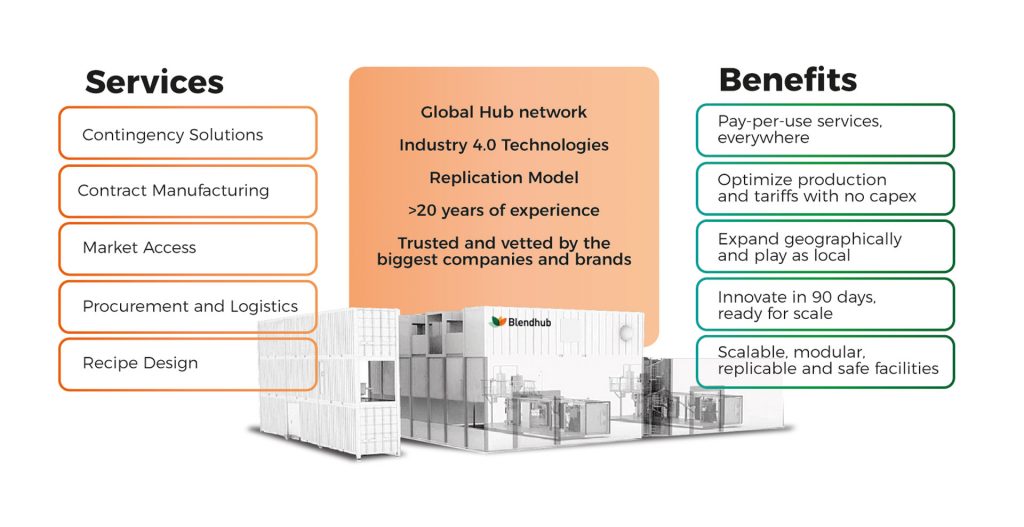
Full flexibility is a luxury not many companies can afford. Within our cloud-connected production hub network, you can respond faster to peak demands, work complex recipes, test formulations, manage allergens, expand production lines, or substitute unavailable ones with ours.   

Optimize operations and processes  

You can streamline procurement and logistics by sourcing raw materials locally, producing near your target market, and distributing according to the best tariffs and trade routes. Furthermore, with us, you can develop and produce tailormade premixes that will save you time and resources when managing ingredients, from purchase and storage up to weighing and application.  

Expand your geographic reach  

Instead of acquiring or building new facilities, working with us allows you to reach other geographies by producing locally with the highest standards. Our identical, modular production facilities, our experienced staff, and our replicated processes enable you to enter new markets anywhere. Benefitting from our local teams’ expertise and network, you will be able to play as a “local,” gaining market access and insights on how to adapt to local conditions and tastes.  

Innovate faster  

How long does it take to ideate, develop a new product, test it on the market, and scale production? Most companies say it can vary from several months up to several years.   

Using our local production hubs can speed up development and launch to as fast as 90 days, without fixed investment in R&D. We have the pilot plants to host your trials, the flexibility to accommodate your market tests, and the capacity to scale-up production as needed.  

More than toll manufacturing  

At this point, you have realized that Blendhub offers much more than the usual co-packer.  Our unmatched Service Suite offers food and ingredient production services in a flexible pay-per-use system.   

  • Contract manufacturing. Core services include high precision blending with the option of liquid injection, and full technical support. 
  • Recipe design. Upon request, our technical teams will help to formulate a new functional blend or adapt a recipe to local needs. Our customized formulations always fit customers’ expectations of quality, functionality, and costs. 
  • Procurement and Logistics. Using advanced data analytics, Blendhub can find the best raw material providers, optimize tariffs, and predict the most advantageous trade routes for you. 
  • Market access. Our local teams can leverage their expertise when you are looking into entering a specific country. We have helped many companies to minimize risks and finding the right partners all over the world.


Highest quality and safety, anywhere 

The main reason our customers trust us with their products is that we deem quality and safety as the absolute priority. We will spare no effort when accessing the most advanced technology. All our hubs use the same Quality Control hardware and software, and share results on the cloud in real-time.  

Our systems are based on the software Chemometric Brain. It uses Near-Infrared Spectrometry (NIRS) to provide our customers with maximum recipe accuracy.  The technology enables us to control every raw material and final product, preventing food fraud, allowing us to react immediately to inconsistencies, and ensuring the precise replication of recipes in any of our production hubs.  

Besides being certified for FSSC22000, all our hubs are FDA, CODEX, or CE compliant. Depending on location, also for ISO 9001, ISO 14001, OHSAS 18001, ISO 45000, and FSSAI. Over the years, we have been validated and vetted by the biggest companies in the Food & Beverage industry. 

Partnering in new deployments  

Most of our customers use our pay-per-use services to develop new premixes and to produce within our global hub network.  

However, many companies look for a way to boost their production capacity on a specific location, near their raw material sources or their processing plants.  

Our modular and replicable food production hubs have proven to be the ideal solution for those partners. The entire facility can be set up on any location in less than six months. All production machinery and systems fit a 40’ container and, upon arrival, the production unit is assembled and start operating in only 72 hours.  

Currently, we have two partner production hubs under development in North America. We are planning new deployments to South America, East Asia, the Middle East, and Australia in the next two years.  


Stimulating the circular economy   

There are two ways we help customers to be more sustainable. Firstly, working with food powders allows us to save much of the transportation and emissions compared to working with liquids and fresh produce.  

Moreover, by producing next to raw material sources or the consumer market, you are also reducing your carbon footprint, boosting local economies and empowering communities.  

Blendhub’s business model has been regarded by several institutions as one of the most impactful solutions to promote the circular economy worldwide.  

We are proud of contributing to the UN’s 2030 Sustainability goals 2, 12, and 17. We are happy to partner with any company or brand that shares the same values.  

Ready to explore opportunities?  

Our goal is to make the beverage industry more resilient to unforeseeable events and to bring safer and better food products to the market faster. Contact us now to start innovating with new products and premixes, optimizing your operations, and reaching new markets like a local player. We are looking forward to hearing from you! 

Blendhub was featured in a article from Food News International on April 20th, 2020.


The Food News International team interviewed Blendhub´s founder and CEO, Henrik S. Kristensen, about how Blendhub replication model helps health care facilities.  Read an excerpt of the interview below or find the original article here.

The Singapore-based media Food News International which covers breaking news and discover trends happening in the food manufacturing industry, published an interview with Blendhub´s founder and CEO Henrik S. Kristensen. In the article, Henrik explains how powder-based food is important and efficient for healthcare facilities to meet their patient’s nutritional needs during the COVID19-pandemic. Furthermore, he explains how Blendhubs replication model support hospitals, medical staff etc. by replacing specific meals and providing nutritional replacements based on powder.

Blendhub was featured in two articles from AMEinfo on April 15th and 16th, 2020.


Reporters Mark Anthony Karam and Hadi Khatib from AMEinfo interviewed Blendhub´s founder and CEO, Henrik S. Kristensen, about Blendhub´s history and the company´s disruptive model. Read a excerpt of the feature below or find the original reports with Mark Anthony Karam here and with Hadi Khatib here.

Blendhub’s founder and CEO, Henrik S. Kristensen, was interviewed on the online business portal AMEInfo, which focuses on economic and business information for Middle East. In two detailed reports, Henrik first tells about Blendhub’s history and evolution and then explains how the company’s disruptive model, based on multilocalisation and technology, can help 500 million small and medium enterprises compete with the big brands in the global agrifood market.


Want to know more about Blendhub and what we do? Contact us here

Blendhub was featured in an article from Agencia EFE – Efeagro on April 5th 2020.

Spanish hospitals reinforce their food services to feed patients and staff


Efeagro reporter, Belén Delgado, featured Blendhub about our impact on meals for Spanish hospitals during the Covid19 – pandemic. Read a translated excerpt of the feature below, or find the original article in Spanish here.

The increase in the number of patients affected by coronavirus in Spanish hospitals has led companies that provide the menus in these centres to reinforce their services to patients and healthcare workers. The report highlights Blendhub’s proposal to increase efficiency and avoid contagions in hospitals by providing these places with meals based on powder which require less manipulation and meet the patients nutritional needs in a more efficient way. By reducing fresh food to powder, ingredients that can be packaged and combined in recipes to suit hospital requirements.


Want to know more about Blendhub and what we do? Contact us here