Partnership with Essence Food to develop innovative products from food surpluses
Blendhub joins a new partner in its service platform for the food industry: Essence Food, a company specialized in the transformation of surplus food to reduce waste.
Both companies share the vision of optimizing the use of raw materials to ensure the entry of new ingredients into the value chain by transforming them into innovative, affordable products with high nutritional value and longer shelf life.
Essence Food is committed to the exploration and use of exponential technologies to optimize production and consumption surpluses. With a sophisticated dehydration technique, already tested among consumers, it generates new powdered products that retain all their organoleptic qualities even in adverse climatic conditions for more than five years.
“We will work together to integrate these ingredients in novel formulations and explore new ways to reach the industry and final consumers with a proposal that has full traceability and transparency from the origin, so that consumers know at all times what they are eating,” says Marcio Barradas, founder of Essence Food.
These new formulations will also be valid for 3D printing, a technology that optimizes the use of food and fosters personalized nutrition: starting from the digital recipe, printers can replicate it by combining the different powdered ingredients.
Essence Food’s activity is fully aligned with Blendhub’s business model and mission, which operates a global and multi-localized network of Food-as-a-Service hubs with the aim of producing more efficiently and sustainably.
Henrik S. Kristensen, founder and Chief Moonshot Officer of Blendhub, explains the scope of the agreement: “As well as reducing food waste by maximizing our circular economy model, our goal is to make basic nutrition available to more people in more places. And this can only be achieved through platform collaboration with partners like Essence Food, with whom we share vision and values to accelerate value creation in the supply chain and in society.”
Essence Food offers its technology and expertise in lyophilization and Blendhub offers its Food-as-a-Service platform to help food companies design, produce and launch new food products anywhere in the world through a network of hubs in four continents; and Digitized Food Quality to validate new ingredients and formulations using Chemometric Brain software.
Other strategic partners have recently joined Blendhub’s collaborative platform model, such as Nucaps, a company developing functional ingredients through nanotechnology, and Qina, a leading international platform for personalized nutrition solutions.
Middle East is an expanding market, strategically located, and with a fast-growing population, which is generating huge growth opportunities for international food and beverage companies and investors. And it has always been one of Blendhub’s target regions.
New consumption trends are on the rise in the region, in a context of increasing consumer concern for health and the environment, such as alternative proteins, dairy alternatives and plant-based food products.
Thus, once again this year, and despite the difficulties caused by the pandemic, our Middle East sales team will be at Gulfood, the largest annual food and beverage trade exhibition in the region, a must-attend meeting point for all those who want to be updated on production and consumption trends and prepared for the upcoming challenges in the food industry.
With the desire to discuss with our customers, partners and friends in Middle East about our competitive and innovative solutions, our sales team will bring to Dubai Blendhub’s portfolio with the newest solutions in plant-based products, dairy and powder innovative mixes.
At Blendhub we keep innovating to provide our clients with the best solutions to capture opportunities in the food industry in Middle East. Through our Food-as-a-Service concept, we can help any food company adapt their product portfolio to new consumer trends and launch new products in less than 90 days.
Our service model goes way beyond recipes and production. Through our global network of multi-localized production hubs on 4 continents, we offer our services from ideation to final product launch worldwide, in a simple pay-per-use model with no need for CAPEX investments in own infrastructure.
Our team in Gulfood will be delighted to plan an appointment with you and exchange ideas to continue adding value to the food value chain.
Contact for more info.
Begoña Amat Arocas
Sales Manager – Middle East
Sadiyah Palekar
Pedro Belmonte Pérez
BD & Technical Support Manager
Technical / Middle East
Business Development Manager
Control Tower / Factory Operations
Blendhub, which operates the world’s first multi-localized network of powder-based food production hubs, and Nucaps, a nanotechnology development platform created in Spain, awarded as the most innovative foodtech startup in 2021, have signed a strategic alliance to develop personalized functional ingredients for the nutrition and health industries.
Nucaps and Blendhub work with complementary technologies and both stand out not only for their innovations in the segment of functional ingredients and personalized nutrition, but also for their service-based business models. With this alliance the two platforms will be able to share their technological developments, infrastructure and knowledge in order to continue innovating and capturing growth in the health and nutrition industries.
Nucaps has developed a pioneering encapsulation technology for the industrial development of nanocapsules and biocapsules for bioactives and probiotics. These natural protein capsules improve the preservation of the active ingredients, providing them with greater efficacy and stability, and are free of preservatives. In addition, the technological capacity of Nucaps enables to personalize food products and adapt the developments to an infinite number of substances, applications and final recipes.
These microencapsulated powdered ingredients (antioxidants, probiotics, flavors, essential oils, vitamins, anticarcinogens…) can be introduced into all types of food matrices and provide additional nutrients to improve health, for example, to strengthen the immune system, prevent obesity, regulate metabolism or delay aging, among others.
On the other hand, Blendhub provides Nucaps and its customers with its Food-as-a-service platform to help any food company design, produce and launch innovative food products anywhere in the world. In addition, Blendhub offers Infrastructure-as-a-Service to produce locally, closer to raw materials and final consumers, through a network of portable factories, now on four continents; and finally, it will facilitate the validation of new ingredients and formulations through Chemometric Brain’s software-as-a-service.
We face a new year still with our lives and our professional activity limited by the pandemic and in a difficult economic context, with rising energy and raw material prices that are conditioning the recovery in many sectors.
And yet, at Blendhub, we can be satisfied with the results achieved in the past year, confident about what is to come and optimistic about the future. Our clients and partners can feel reassured, since our service model through a multi-localized platform has proven to be resilient, flexible and efficient to face crisis, enabling us to continue providing optimal services and meeting our business objectives in 2021 despite a difficult economic context.
In the past year, we continued helping SMEs, startups, but also large multinationals that rely on our know-how and experience, to innovate, to tackle new markets and to create more efficient and sustainable supply chains thanks to our service model with three pillars: infrastructure-as-a-service through our network of multi-localized production hubs on four continents; food-as-a-service and digitization of quality and supply chains.
In addition, we reinforced our platform model through partnerships with people and organizations that share our vision and values and are strategic to continue changing the game in the global food production system. In 2021 we have signed collaboration agreements that are already delivering benefits: With eKutir in India for a project to create value and traceability in the Ragi supply chain, contributing to the local development of this crop and to produce more nutritious and sustainable food; with the international consulting firm Qina to create together an ecosystem for the development of personalized products aimed at both the food and pharmaceutical industries; and with the international NGO Feed a Billion, with whom we have launched the Nourishe project to supply nutritious food to developing girls in communities in need.
On the other hand, we intensified our presence in international events that helped us increase visibility and impact: at the Food 4 Future tradeshow in Bilbao in June, Blendhub won the award to the best sustainability initiative in the food industry; at the Future Food Forum in Dubai in October, I had the opportunity to explain Blendhub’s model to hundreds of international industry leaders and the Government of the United Arab Emirates; at Ftalks, the Km Zero Hub initiative, we achieved significant impact and contacts for the business…
In all these events we positioned as what we are, a technological platform at the forefront of the food industry.
This was supported by our Virtual Reality project, which we launched this year together with Marcus Shingles. This is a very powerful marketing tool that helped us show our stakeholders and potential customers what we can reach and do for them.
It has been an intense and successful year, but we want more. In 2022, we will focus on expanding our network of hubs; we will continue developing our food-as-a-service model and expanding our open platform to all industry operators interested in sharing value and knowledge.
We are nonconformists and ambitious to achieve our purpose of producing in a more efficient, safe and sustainable way and making healthy and nutritious food available to more people in more places. And this is only possible by collaborating through a platform of services open to the participation of those professionals and companies that share values and ideas with us to create value for society.
I wish you and your loved ones health, happiness and success in the new year.
Founder and Chief Moonshot Officer at Blendhub
Qina, an industry-leading platform for personalized nutrition solutions, and Blendhub, operating the world´s first global network of multi-localized food production hubs, have signed an agreement to create an ecosystem for the development of powder-based personalized nutrition solutions that are evidence-based, affordable and from sustainable sources and supply chains.
The scope of this collaboration is to create opportunities and projects which translate science into innovative solutions for other companies and organizations; to identify and measure the impact on health and the environment arising from these new solutions and to support research in priority areas that align with Qina and Blendhub strategies.
As a leading consultancy and platform for personalized nutrition projects, Qina will provide Blendhub with strategic guidance, insights, and leadership in relation to personalized nutrition technologies, industry trends, scientific advances, and consumer behaviors, as well as access to a database of companies and approved functional ingredients which can be used in Blendhub Food-as-a-Service offerings.
Blendhub will contribute to the project by offering their localized food production Infrastructure-as-a-Service (IaaS) model, which enables access to patented technology and a global replication model closer to raw materials and final consumers; a Food-as-a-Service platform to help food companies design, produce and launch new food products anywhere in the world; and Digitized Food Quality-as-a- Service to validate all new ingredients and formulations using Chemometric Brain’s software.
The ecosystem to ideate and develop innovative and science-based personalized nutrition is open to partners who share values and vision with Qina and Blendhub.
The Qina platform is the first industry-leading curated database of personalized nutrition solutions offering nutrition consultancy, advisory, research and innovation services to companies operating in the food, personalized nutrition, digital health, food, ingredient and consumer health industry. Qina’s mission is to connect key stakeholders in personalized nutrition to develop evidence-based solutions that have a real health impact and benefits.
Blendhub has evolved from a branded food ingredients solutions provider to become a technology and Food-as-a-Service platform helping people and companies from ideation to launch of new food products faster and safer, addressing new markets and final consumers by competing on agile innovation without the need for proprietary investment in infrastructure, due to a global network of multi localized food production hubs operated as-a-service model on four continents.
Our founder and CEO has been recognized by US World’s Leaders Magazine for leading a global change in the food industry
This week US World’s Leaders Magazine recognized Henrik S. Kristensen as one of the world’s 10 most influential business leaders making a difference in 2021. This is definitely a very significant support for Henrik and Blendhub to continue boosting the food production localization movement and changing the game in the global food production system.

Henrik states, “I want to lead a change in the agri-food value chain that enables access to basic nutrition in a safer, easier and more efficient way, reaching more people in more places. We cannot tolerate having anyone going hungry to bed or suffering diseases or malnutrition because of bad food products or lack of availability of the right ingredients. It is a difficult and ambitious goal which obviously requires 110% dedication. But for me it is not a job, but a project of life”.
Changing the global food production system is not easy: the food industry, in most countries, is still quite traditional, with few digitized processes and production centralized on large static factories located in Western countries resulting in long and inefficient supply chains.
A few visionaries, among them our founder Henrik S. Kristensen, thought more than a decade ago that this system was unsustainable, both from an economic point of view, because it increases costs, and also from a social point of view, since centralization of production does not allow the development of local economies; and, of course, environmentally, since raw materials must travel long distances to production centers and final products again until they reach the consumer, which means more transport and more gas emissions into the atmosphere.
Our founder and CEO, Henrik S. Kristensen, with a professional and personal background linked since his youth to the food industry, saw it clearly from the beginning: the solution should be decentralizing and multi-localizing food production, closer to raw materials and final consumers. And in 2011, together with a team of engineers, they developed and patented the first portable factory (Portable Powder Blending), which was first deployed in India.
Since then, Blendhub has deployed a network of multi-localized food production hubs on four continents. We have been the pioneers of a system that big conglomerates are already joining. As an example, last January Unilever announced to have developed what they have called a “travel factory” in portable shipping container with the aim of facilitating localization of production.
This path that our founder Henrik S. Kristensen opened more than a decade ago is now gaining recognition among multinationals and other stakeholders in the agri-food industry, but also by international organizations seeking for a fairer and more sustainable development and by the mass media.
Since Covid burst into our lives a year and a half ago, a lot has changed in the ways of working. The pandemic forced millions of workers around the world to do telework. This is something that we at Blendhub had already been experiencing since we are a multinational and multi-localized platform, with headquarters in Murcia (Spain) and factories in 7 different countries.
We already had an established culture of multi-localized remote work and online teams and people coordination practices. But the pandemic accelerated this trend and the context pushed us to be even more flexible. As a result, in the last year, we have significantly increased the hiring of multi-localized employees in different parts of the world. I would go further to say that when it comes to recruiting talent, the origin or location of the employee is now secondary.
In this context, how do we handle virtual recruiting and onboarding? And the main question is: would you hire someone you have never seen in person?
At Blendhub we have accepted the challenge with very good results.
Most recruitment processes for office staff have been managed online, from the publication of the job offer through Linkedin and on our website. The first contact during the selection process is made by email and then through interviews via Teams and ATS video interview system where the candidates record themselves answering a series of questions.
How do we make virtual recruiting work well? Adequate investment in technology and better-recruiting tools are essential for an effective recruiter performance.
What about welcoming new colleagues? Is it easy to integrate new employees virtually, without physical contact? At Blendhub we have designed detailed onboarding plans that we carry out entirely online in different stages to ensure employees’ integration into their new teams as soon as possible. First, a series of short video calls are scheduled with each department to welcome newcomers, as well as other online meetings specifically for training. From there, weekly follow-up meetings are held to ensure the contact of multi-localized employees and teams under the 5/30/60 methodology.
We use Microsoft Teams as a basic communication platform and internal communication plays an essential role to keep employees and teams connected and motivated.
To date, 100% of the virtual recruiting processes delivered good results and proved that technology helps us recruit talent easily and efficiently and attract the best professionals in their field regardless of where they live or where they work.
The whole world is getting faster and technology is the pacemaker for change. The Covid pandemic has further accelerated this trend because some people understand that fast technology adaption can give us superpowers which can move us from linear to exponential growth. An example we all know is that during Covid employees were confined to work from home, but technology has allowed us to stay connected by providing us with the right tools to facilitate communications and thereby doing much smarter business than before.
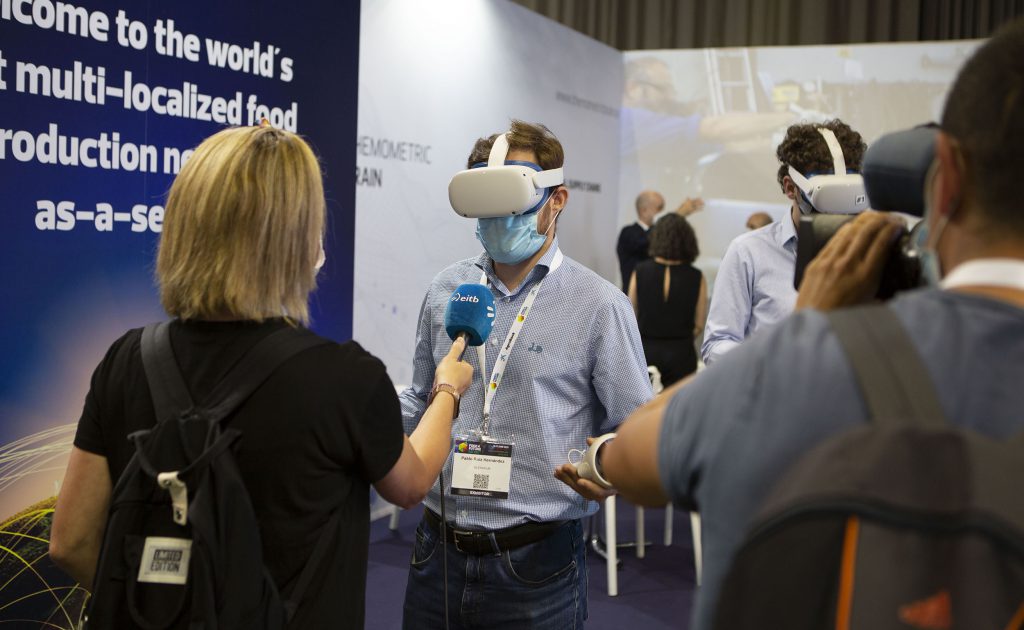
Adapting innovative solutions and new technologies is a part of our Blendhub DNA. That is why we decided to develop an immersive Virtual Reality experience and make it available to any person or company interested in launching new food products, accessing new markets and localizing sustainable food production anywhere in the world by offering a virtual visit to our infrastructure-as-a-service model and our network of hubs today present on four continents.
With a global food industry, still quite traditional and reluctant to change, we believe that the best way to overcome doubts around why digitization and new technology adaption is important, is by letting people experience in virtual reality how our global service model can help anyone in a fast and inexpensive manner to improve their competitiveness, collaborate and continue growing their business in a sustainable and inclusive way.
Platforms like Spatial are making Virtual Reality increasingly accessible and is now facilitating a fast and immersive experience which we have decided to use to help our customers experience how our portable powder blending units (PPB) being the core in our local hubs is the main reason why we can deploy and localize food production anywhere in the world faster, safer and cheaper than ever before.
A local hub is much more than a fully digitized production facility because our goal is to add more and more hubs to our global network and thereby facilitate sustainable supply chains and launch of healthy new food products anywhere in less than 90 days.
Do you imagine explaining all this in a traditional company brochure or webpage, for someone at a food trade show or with a PowerPoint presentation during a 15 minutes online call?
We have tried all this for nearly a decade and best outcome has been that someone interested travelled from far to visit one of our actual network hubs in Spain, Mexico, Colombia or India.
Now you can do all this without leaving your sofa and you can even invite your entire project team or even C-suite along to a Virtual Reality Tour transporting you directly inside one of our hubs and giving you the possibility to interact with our global or local specialist, who in real time will show you our infrastructure or production processes or even tell your more about how we have developed from being a product company selling our own brands to become a service company caring about your success.
We are grateful for our collaboration with Spatial, Marcus Shingles and his Exponential Destiny Team helping us bringing our business into the “fourth dimension” because we can only accelerate and impact together.
To visit Blendhub at Spatial, all you need is a pair of Oculus Quest glasses and access our private space, free of charge, quickly, without moving from your home or office.
Contact our Global Operational Excellence Manager Pablo Ruiz Hernandez for more information.
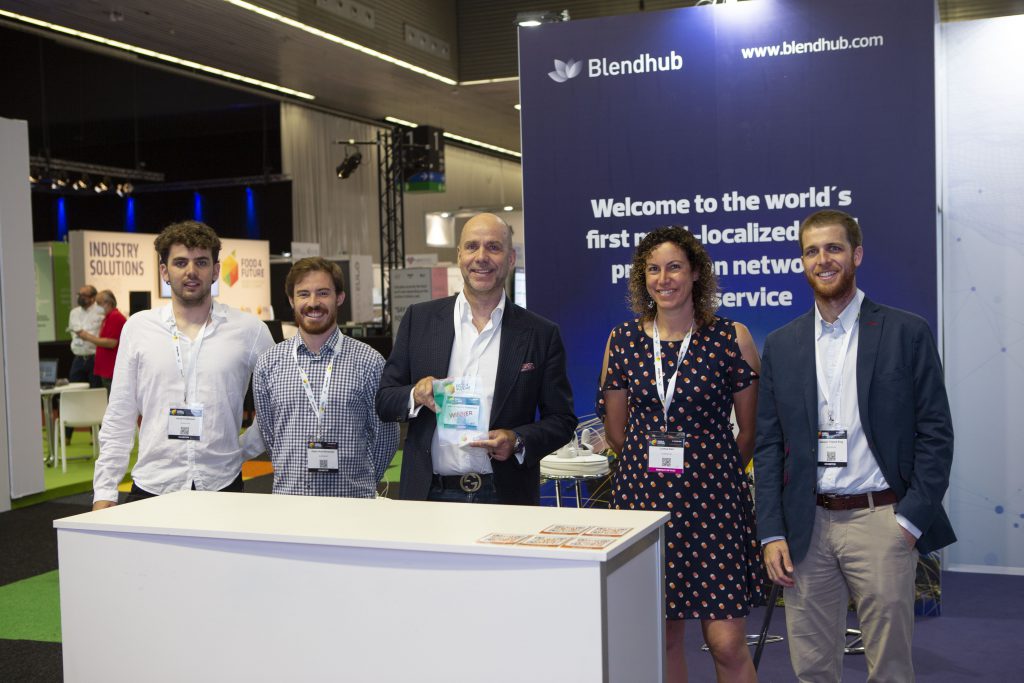
- The company won the award for the Best Sustainability Project in the Food Industry at the Foodtech Awards.
By 2050, the world’s population will reach 10 billion. Feeding the entire population is a challenge that cannot be tackled with traditional solutions. The first edition of Food 4 Future made it clear that only through technology and innovation will we be able to feed the population in a safe, sustainable and healthy way.
And in this context Blendhub has a lot to say, as we were visionary when implementing a multi-localized production model, closer to raw materials and final consumers, through portable factories that can be deployed and operational in less than six months anywhere in the world, for a more efficient and sustainable food production.
This infrastructure-as-a-service model was presented at the first edition of Food 4 Future. And we have gone a step further by introducing it through virtual reality, which demonstrates that technology is our main ally to continue developing a digitized platform to help any agri-food company from ideation to launch of sustainable food products anywhere in the world. At Food 4 Future, our founder and CEO, Henrik S. Kristensen, gave a keynote speech to introduce this business model and explain how digitized platforms can create value throughout the supply chain.
Our global operations manager, Pablo Ruiz Hernández, explained Blendhub’s infrastructure-as-a-service model for a more sustainable food production; and our marketing manager, Juanjo Valderrama, detailed how data are used to choose the best markets and categories to innovate and compete. Finally, Spain’s hub manager Sergio Bravo introduced Blendhub’s global service model to help create all types of recipes, with all types of ingredients anywhere in the world.
Blendhub’s business model was recognized at the Foodtech Awards with the award to the best sustainability project in the food industry, which makes us feel proud and boosts our platform-based project to which we welcome all industry stakeholders who wish to collaborate and create joint value in the global supply chain.