The Human Resources Management Association of the Region of Murcia (DH), which brings together professionals in this field, has awarded the VI Human Management Awards. These awards recognize the work of professionals and institutions that develop and promote people management in Murcia.

Raúl Fernández Guillamón, VP of Business Services at Blendhub, received the DH CEO Award. The DH Award for Human Resources Director went to Manuel García Juesas, Human Resources Director at El Pozo Alimentación; while the DH Institutional Award went to the Faculty of Labour Sciences at the University of Murcia.

Raúl is a psychologist with a Master’s Degree in HR Management and a Master’s Degree in Business Management and Administration. He founded the company INDDEC Consultores and was managing partner. Previously, he had worked as Human Resources Director at Bioferma Murcia. Throughout his professional career, he has promoted start-up companies and management teams in four countries. He has collaborated in the creation of company culture, work models, roles and responsibilities, remuneration and results. He also has extensive teaching experience.

Passionate about how relationships and human behaviour influence business results, at Blendhub he is helping “to lead change in the food value chain to make food available to more people, in more places, in a sustainable way.”

In terms of people management, Blendhub stands out for having obtained ISO 45001 certifications in Health and Safety, promoting the third equality plan and committing to the initiative of companies free of gender-based violence.

After Covid and with a war going on in Europe, it is becoming clear to everyone that the future of food will become local and operate in digitally accountable global supply chains.

When in February 2004 we inaugurated our “static” factory and production hub in Murcia (Spain) after nearly 36 months of planning and execution amounting to a total investment of about 15 million euros, I fully realized that I had made the biggest mistake of my professional life so far.

Bringing the ingredients needed for our food solutions from around the world to Spain and then exporting to other countries and continents made it clear to my team and me that this was not sustainable.

This was something I had thought a lot about since 1986 in my first job in the food industry where my company brought dried raw materials from very far away to a production plant in Denmark, something seen as an industry standard based on the idea of operating big factories with an economy at scale and long pay back.

But from that moment on, I understood that I had to go for what I believed in because it was obvious to me that this food system was unviable and would not be able to stand forever.

In 2004 we were manufacturing a blend of different food ingredients with a major ingredient being guar gum that we imported directly from India or bought from local Spanish distributors before blending with other ingredients, packaging the final recipe, and doing exhaustive QA/QC before selling it afterward outside Spain.

And I thought: why not invent a production unit which we could bring closer to the origin of raw materials and to our customers?

I challenged my engineers to invent and design a prototype, easy to transport and install anywhere in the world, and in case of change in business opportunities we would be able to remove and set up in a new location becoming the core of a novel Blendhub global replication model. This is how we invented and patented in 2010 the Portable Powder Blending unit (PPB), a portable factory that can be transported in a 40-foot container and be operational anywhere in the world in less than six months. In 2011 we inaugurated our first production hub in India, we moved our food solution using guar gum to India and the result was a price 30% lower compared to production in Spain with exactly the same quality and functionality, food safety, and security.

Today more than a decade later, we have deployed 7 hubs on 4 continents and now expanding in close collaboration with food industry partnerships and investors interested in adding their location to the world map of this proven platform business model. This is how we became pioneers in taking localized food production from idea to reality and today accelerating a global network of multi-localized hubs.

Last week I was positively surprised to read that American company Relocalize has raised funding of 1.4 million dollars to install a series of portable food production factories in different parts of the USA to be more efficient and reduce emissions.

The future of food is local, says Relocalize CEO Wayne McIntyre. Indeed, at Blendhub we were visionaries more than 10 years ago when we launched our model, and we are excited that other industry stakeholders are joining the model. Because changing the global food system requires efficient alternatives and with our and other companies’ solutions, we have demonstrated how a reduction in handling and transportation is not only reducing final food prices but is also directly impacting CO2 emissions. And this can be expanded further because by empowering local communities to use their locally available ingredients, more diversified crops, and even implementing regenerative agriculture this positive impact can grow exponentially.

And as many might remember, over a year ago the global food conglomerate Unilever also announced that it had developed a so-called travel factory to produce more efficiently and sustainably anywhere in the world.

Welcome, Relocalize, Unilever, and all those who want to join the localization movement because the tipping point is near.  And only through the collaboration of all stakeholders in the agrifood value chain, we can ensure the supply of healthy and affordable food and nutrition in sustainable global supply chains to all people in all places.

Blendhub will participate in the first edition of the Ftalks Food Summit in Mexico. The leading event on food innovation in Spain crosses the ocean and will be held for the first time in Latin America, where food tech is booming, which involves greater growth opportunities for food companies in this region. Blendhub, with an important commercial presence in the region and two Food-as-a-Service hubs in Mexico and Colombia, has been invited to present their innovative business model based on localization of production, closer to raw materials and final consumers. This strategy allows us to help companies to produce anywhere in the world in a more efficient and sustainable way while creating local value. Eduardo Aldasoro, Regional Managing Director Americas for Blendhub, will participate in Ftalks Food Summit in Mexico in the round table: Reformulating mass consumption: healthier, more sustainable and delicious products. He will explain how Blendhub’s localized model facilitates tailor-made solutions for food manufacturers, adapting recipes to local consumers, ensuring more efficient business strategies and more sustainable food products. The event will be held at Torre Diana in Mexico City on September 1 and 2. Numerous startups from the region will attend and exhibit their products and technologies in a ‘future market’.  The congress will bring together top industry leaders from around the globe.

With more than 20 years of combined experience and leadership in the Food Industry, Venture Capital and Applied Innovation, 12 of which in the UAE, he joins Blendhub to lead the platform’s deployment in the Middle East.

Blendhub has appointed José Francisco Fernández Serna as Managing Director in the Middle East to lead the deployment of the platform in the region and consolidate growth in a key market for the company due to its strategic location, population growth and new business opportunities arising from current food trends. This set up is also fully aligned with the national Food Security and Industrialization agendas in UAE and all the countries in the Gulf Region.

José Francisco brings a profound experience in the Middle East having founded, led and exit previous businesses in Food Ingredients, and serving as strategic advisor, board member and subject matter expert in different public and private organizations.  He holds a PgD in Business Administration from Harvard Business School (General Management Program) and is a senior executive, entrepreneur and investor with more than 20 years’ experience in managing international expansion and operations in the food and beverage industry, as well as involved in digital transformation, acceleration and venture capital for the last 12 years in the United Arab Emirates (UAE).

He is member and rapporteur of the innovation panel of experts for the European Institute of Innovation and Technology (EIT Food), body of the European Union and pioneer Private Public Partnership (PPP) in the Food Value Chain, with main competences in evaluating, assessing and securing funding for strategic projects in food innovation, food security and food sustainability related to the food system, connecting Academia, Research Centers, Corporate and Government Institutions.

He is also Board Member of the UAE Spanish Chamber of Commerce; member of the Board of Directors of the Association of Spanish Scientists and Researchers in UAE and representative in the Steering Committee of In5 (Dubai Government Incubator), among other positions. He combines a deep knowledge of the business ecosystem in the Region with and a solid track record of achievements in the Gulf Countries that will help Blendhub establish strategic partnerships to consolidate growth and continue creating shared value in the Middle East.

José Francisco is currently working with different operators interested in producing in the Middle East to define their participation in Blendhub’s platform in UAE

During its annual meeting in Davos – the focal point for leaders to accelerate the partnerships needed to tackle global challenges and shape a more sustainable and inclusive future-, the World Economic Forum released a paper that calls for new collaboration between organizations, businesses, investors and entrepreneurs to attract the investment needed to strengthen fragile communities and unleash sustainable social impact. And Blendhub has been selected as one of the world organizations with the capacity and strategic thinking needed to develop sustainable solutions to make a difference to the lives of nearly 1 billion people living in fragile and conflict-affected settings worldwide: “Blendhub focuses on creating sustainable and transparent supply chains that ensure shared value creation by connecting local farmers to entrepreneurs and food brands across global supply chains. In a decentralized winner shares it all approach to doing business, it dedicates a certain amount of capacity at each hub to social collaboration and sustainable food design for underserved communities”. “It takes more than a single intervention to unleash transformational change in complex ecosystems. To truly leverage the potential for positive and sustainable social impact while meeting investor demand for returns, new ways of collaboration across sectors are needed,” said Børge Brende, President of the World Economic Forum. Henrik Stamm Kristensen, Founder and Chief Moonshot Officer at Blendhub, states: “This is what we at Blendhub have been claiming for decades as we were pioneers in creating a multilocalized network of food production hubs on 4 continents, closer to raw materials, creating local value and making healthy and safe food products available to more people in more places”. This discussion paper is an evolution of the work initiated by the Forum’s Humanitarian and Resilience Investing (HRI) Initiative, which was launched at the World Economic Forum Annual Meeting 2019. The IKEA foundation is a partner of this initiative. Over the next three years the partnership will develop innovative business models and investments that strengthen local economies and increase the self-reliance and resilience of the most vulnerable communities and economies. Download the discussion paper

Qina, an industry-leading platform for personalized nutrition solutions, and Blendhub, operating the world´s first global network of multi-localized food production hubs, have signed an agreement to create an ecosystem for the development of powder-based personalized nutrition solutions that are evidence-based, affordable and from sustainable sources and supply chains.

The scope of this collaboration is to create opportunities and projects which translate science into innovative solutions for other companies and organizations; to identify and measure the impact on health and the environment arising from these new solutions and to support research in priority areas that align with Qina and Blendhub strategies.

As a leading consultancy and platform for personalized nutrition projects, Qina will provide Blendhub with strategic guidance, insights, and leadership in relation to personalized nutrition technologies, industry trends, scientific advances, and consumer behaviors, as well as access to a database of companies and approved functional ingredients which can be used in Blendhub Food-as-a-Service offerings.

Blendhub will contribute to the project by offering their localized food production Infrastructure-as-a-Service (IaaS) model, which enables access to patented technology and a global replication model closer to raw materials and final consumers; a Food-as-a-Service platform to help food companies design, produce and launch new food products anywhere in the world; and Digitized Food Quality-as-a- Service to validate all new ingredients and formulations using Chemometric Brain’s software.

The ecosystem to ideate and develop innovative and science-based personalized nutrition is open to partners who share values and vision with Qina and Blendhub.


The Qina platform is the first industry-leading curated database of personalized nutrition solutions offering nutrition consultancy, advisory, research and innovation services to companies operating in the food, personalized nutrition, digital health, food, ingredient and consumer health industry. Qina’s mission is to connect key stakeholders in personalized nutrition to develop evidence-based solutions that have a real health impact and benefits.

Blendhub has evolved from a branded food ingredients solutions provider to become a technology and Food-as-a-Service platform helping people and companies from ideation to launch of new food products faster and safer, addressing new markets and final consumers by competing on agile innovation without the need for proprietary investment in infrastructure, due to a global network of multi localized food production hubs operated as-a-service model on four continents.

BLENDHUB, S.L ha conseguido una subvención gracias al proyecto “DESARROLLO DE NUEVAS RECETAS DE SOLUCIONES EN POLVO, SALUDABLES Y SOSTENIBLES, PARA LA PRODUCCIÓN INDUSTRIAL DE SMOOTHIES Y HAMBURGUESAS VEGETALES” otorgada por el Instituto de Fomento de la Región de Murcia y cofinanciada en un 80% por el Fondo Europeo de Desarrollo Regional (FEDER), dirigidas a FOMENTAR LA ID+I EMPRESARIAL EN EL MARCO RIS3MUR.

BLENDHUB tiene como principal objetivo facilitar a sus clientes la máxima calidad en sus productos, cuyo valor añadido distinga al producto del resto y que, además, permita superar las limitaciones técnicas presentes en el sector.

En los últimos años la importancia del efecto que deja nuestra alimentación en el medio ambiente ha aumentado lo que está llevando a reexaminar los sistemas de producción y las dietas agroalimentarias. No se puede negar el efecto que tienen los hábitos alimenticios en el medio ambiente que provocan una pérdida de biodiversidad alimentaria y degradación del ecosistema, así como impacto en la pobreza y la salud mundial.

BLENDHUB consciente de la importancia de la incorporación de la economía circular como elemento clave en la transformación hacia un modelo de desarrollo y crecimiento más innovador, competitivo y sostenible se planteó el presente proyecto con el objetivo general de desarrollar una nueva serie de soluciones en polvo basada en subproductos agrícolas, con alto valor añadido, de aplicación en sectores con gran potencial de crecimiento como son las bebidas vegetales y las alternativas cárnicas. Gracias a estos desarrollos se logra mejorar en la calidad nutricional de los productos incrementando la cantidad de fibra y reduciendo la cantidad de azúcar e hidratos de carbono en la dieta. Además, estos nuevos productos permitirán el etiquetado Clean label.

Our founder and CEO has been recognized by US World’s Leaders Magazine for leading a global change in the food industry

This week US World’s Leaders Magazine recognized Henrik S. Kristensen as one of the world’s 10 most influential business leaders making a difference in 2021. This is definitely a very significant support for Henrik and Blendhub to continue boosting the food production localization movement and changing the game in the global food production system.

Henrik states, “I want to lead a change in the agri-food value chain that enables access to basic nutrition in a safer, easier and more efficient way, reaching more people in more places. We cannot tolerate having anyone going hungry to bed or suffering diseases or malnutrition because of bad food products or lack of availability of the right ingredients. It is a difficult and ambitious goal which obviously requires 110% dedication. But for me it is not a job, but a project of life”.

Changing the global food production system is not easy: the food industry, in most countries, is still quite traditional, with few digitized processes and production centralized on large static factories located in Western countries resulting in long and inefficient supply chains.

A few visionaries, among them our founder Henrik S. Kristensen, thought more than a decade ago that this system was unsustainable, both from an economic point of view, because it increases costs, and also from a social point of view, since centralization of production does not allow the development of local economies; and, of course, environmentally, since raw materials must travel long distances to production centers and final products again until they reach the consumer, which means more transport and more gas emissions into the atmosphere.

 Our founder and CEO, Henrik S. Kristensen, with a professional and personal background linked since his youth to the food industry, saw it clearly from the beginning: the solution should be decentralizing and multi-localizing food production, closer to raw materials and final consumers. And in 2011, together with a team of engineers, they developed and patented the first portable factory (Portable Powder Blending), which was first deployed in India.

Since then, Blendhub has deployed a network of multi-localized food production hubs on four continents. We have been the pioneers of a system that big conglomerates are already joining. As an example, last January Unilever announced to have developed what they have called a “travel factory” in portable shipping container with the aim of facilitating localization of production.

This path that our founder Henrik S. Kristensen opened more than a decade ago is now gaining recognition among multinationals and other stakeholders in the agri-food industry, but also by international organizations seeking for a fairer and more sustainable development and by the mass media.

Since Covid burst into our lives a year and a half ago, a lot has changed in the ways of working. The pandemic forced millions of workers around the world to do telework. This is something that we at Blendhub had already been experiencing since we are a multinational and multi-localized platform, with headquarters in Murcia (Spain) and factories in 7 different countries. 

We already had an established culture of multi-localized remote work and online teams and people coordination practices. But the pandemic accelerated this trend and the context pushed us to be even more flexible. As a result, in the last year, we have significantly increased the hiring of multi-localized employees in different parts of the world. I would go further to say that when it comes to recruiting talent, the origin or location of the employee is now secondary. 

In this context, how do we handle virtual recruiting and onboarding? And the main question is: would you hire someone you have never seen in person? 

At Blendhub we have accepted the challenge with very good results. 

Most recruitment processes for office staff have been managed online, from the publication of the job offer through Linkedin and on our website. The first contact during the selection process is made by email and then through interviews via Teams and ATS video interview system where the candidates record themselves answering a series of questions.  

How do we make virtual recruiting work well? Adequate investment in technology and better-recruiting tools are essential for an effective recruiter performance. 

What about welcoming new colleagues? Is it easy to integrate new employees virtually, without physical contact? At Blendhub we have designed detailed onboarding plans that we carry out entirely online in different stages to ensure employees’ integration into their new teams as soon as possible. First, a series of short video calls are scheduled with each department to welcome newcomers, as well as other online meetings specifically for training. From there, weekly follow-up meetings are held to ensure the contact of multi-localized employees and teams under the 5/30/60 methodology. 

We use Microsoft Teams as a basic communication platform and internal communication plays an essential role to keep employees and teams connected and motivated.  

To date, 100% of the virtual recruiting processes delivered good results and proved that technology helps us recruit talent easily and efficiently and attract the best professionals in their field regardless of where they live or where they work. 

The whole world is getting faster and technology is the pacemaker for change. The Covid pandemic has further accelerated this trend because some people understand that fast technology adaption can give us superpowers which can move us from linear to exponential growth. An example we all know is that during Covid employees were confined to work from home, but technology has allowed us to stay connected by providing us with the right tools to facilitate communications and thereby doing much smarter business than before.  

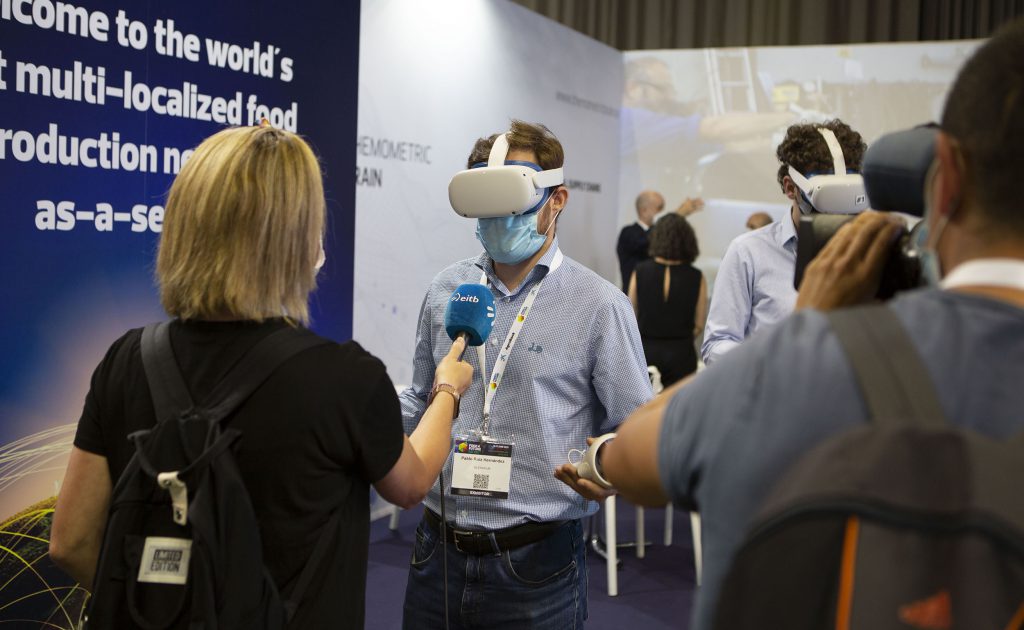
Adapting innovative solutions and new technologies is a part of our Blendhub DNA. That is why we decided to develop an immersive Virtual Reality experience and make it available to any person or company interested in launching new food products, accessing new markets and localizing sustainable food production anywhere in the world by offering a virtual visit to our infrastructure-as-a-service model and our network of hubs today present on four continents.  

With a global food industry, still quite traditional and reluctant to change, we believe that the best way to overcome doubts around why digitization and new technology adaption is important, is by letting people experience in virtual reality how our global service model can help anyone in a fast and inexpensive manner to improve their competitiveness, collaborate and continue growing their business in a sustainable and inclusive way.  

Platforms like Spatial are making Virtual Reality increasingly accessible and is now facilitating a fast and immersive experience which we have decided to use to help our customers experience how our portable powder blending units (PPB) being the core in our local hubs is the main reason why we can deploy and localize food production anywhere in the world faster, safer and cheaper than ever before. 

A local hub is much more than a fully digitized production facility because our goal is to add more and more hubs to our global network and thereby facilitate sustainable supply chains and launch of healthy new food products anywhere in less than 90 days.  

Do you imagine explaining all this in a traditional company brochure or webpage, for someone at a food trade show or with a PowerPoint presentation during a 15 minutes online call? 

We have tried all this for nearly a decade and best outcome has been that someone interested travelled from far to visit one of our actual network hubs in Spain, Mexico, Colombia or India.  

Now you can do all this without leaving your sofa and you can even invite your entire project team or even C-suite along to a Virtual Reality Tour transporting you directly inside one of our hubs and giving you the possibility to interact with our global or local specialist, who in real time will show you our infrastructure or production processes or even tell your more about how we have developed from being a product company selling our own brands to become a service company caring about your success.  

We are grateful for our collaboration with Spatial, Marcus Shingles and his Exponential Destiny Team helping us bringing our business into the “fourth dimension” because we can only accelerate and impact together.   

To visit Blendhub at Spatial, all you need is a pair of Oculus Quest glasses and access our private space, free of charge, quickly, without moving from your home or office.   

Contact our Global Operational Excellence Manager Pablo Ruiz Hernandez for more information.